
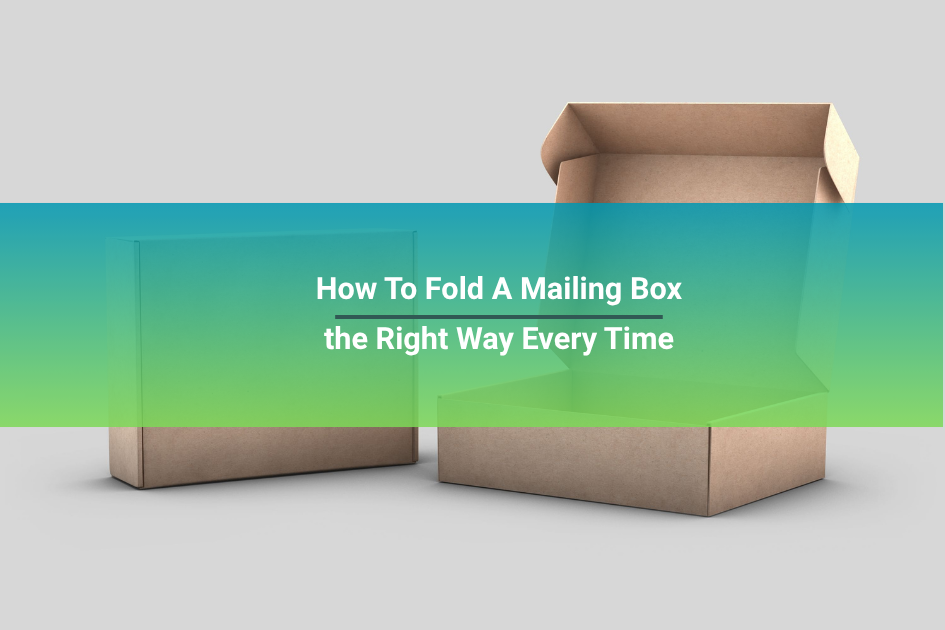
Most people fold a mailing box the same way every time, without giving it a second thought. Then the base gives way in transit, or the tabs pop loose the moment the box gets stacked.
A weak fold isn’t just annoying, it costs money. Broken boxes mean damaged stock, replacement packaging, and parcels that never reach the customer in one piece.
This guide walks through exactly how to fold a mailing box, whether it’s a self-locking design or a standard packing box you’re taping shut, so it holds its shape under weight.
Follow it and every box you fold, whether it’s for mailing, shipping, or storage, comes out strong the first time.
Here’s Everything You Need to Know in Under a Minute
- Self-locking mailing boxes fold and tuck shut with no tape needed, as long as every tab seats flush in its slot
- Standard packing boxes need the H-tape method: shorter flaps first, then longer flaps, sealed with a reinforced “H” of tape
- Skip the quarter fold on any box; it’s the weakest way to close one and the most common reason bottoms give way
- Match the box to what’s going inside it — overloading a box that’s the wrong size is the fastest way to split a seam or pop a tab
- To store or reuse a box, remove old tape, open every flap or tab, and press it flat along its original creases
Table of Contents
How Do You Fold a Mailing Box Step by Step?
Most mailing boxes fold one of two ways: a self-locking base that needs no tape at all, or a standard flap base that’s sealed shut using the H-tape method. Here’s how to do both properly.
Folding a Self-Locking Mailing Box
- Open the box: Pop the flat mailer into its cube shape, pushing the side creases in until the box holds itself square.
- Fold the base flaps: Fold in the two side tabs first, then fold the front and back panels down so their tabs line up with the base slots.
- Lock it in: Press each tab firmly into its matching slot until it sits flush with the base. No tape needed once a self-locking base is properly seated.
- Check it’s flush: Turn the box over and check none of the tabs have popped loose before you load it.
Folding a Standard Flap-Style Packing Box
- Open the box: Stand the flattened box upright and press the side edges together until it forms a rectangle.
- Fold the bottom flaps: Turn the box upside down so the bottom flaps face you. Fold the two shorter flaps in first, then fold the two longer flaps over the top so they meet neatly in the middle.
- Tape the base: Run heavy-duty packing tape along the centre seam, extending it at least 5cm up each side of the box for extra strength.
- Reinforce with the H-tape method: Add a strip of tape along each side edge of the bottom flaps to form an “H” shape. This stops the base sagging or bursting once weight goes in, so never rely on interlocking flaps alone.
- Flip and load: Turn the box the right way up, load your heaviest items first, and repeat the same folding and taping steps on top once it’s full.
That’s the same principle whether you’re working with custom cardboard boxes made to a specific size or a standard carton straight off the shelf.
Why the Type of Fold Matters
Not every fold holds the same weight. The classic quarter fold, where all four flaps fold in without overlapping, looks tidy but leaves a gap in the middle with nothing holding it together.
Under any real weight, that gap becomes the first point of failure. Items fall straight through the bottom, which is one of the most common causes of damage in transit.
Interlocking flaps without tape aren’t much better on a standard carton. They hold their shape while empty, but they’re not designed to bear load, and any bump or lift can pop them open.
The full-overlap fold reinforced with the H-tape method above is the strongest option for anything with real weight in it, from foldable packing boxes right through to bulk shipments.
| Fold Type | Strength | Best For |
|---|---|---|
| Quarter Fold | Weak | Nothing with real weight |
| Self-Locking Base | Moderate to Strong | Mailing, documents, gifts |
| Full-Overlap + H-Tape | Strongest | Shipping, moving, storage |
Common Folding Mistakes to Avoid
- Using the quarter fold on anything heavier than a few hundred grams
- Taping only the centre seam and skipping the side reinforcement
- Reusing a box with old crease lines that no longer sit flush
- Folding a box that’s the wrong size for what’s going inside it
- Forcing a self-locking tab that doesn’t line up instead of resetting the fold
What Tape and Materials Do You Need?
A properly seated self-locking mailing box doesn’t need tape at all. For a standard flap-style box, the fold only works as well as what’s holding it together.
Duct tape and masking tape lose their grip fast, so stick to genuine packing tape rated for parcels, and smooth it down by hand for full contact.
If you’re packing anything fragile, add a layer of bubble wrap inside before folding the top down, so nothing shifts once the box is sealed.
Australia Post’s packing guidelines back this up too, recommending heavy-duty tape and void filler so contents can’t move around once a box is sealed.
Choosing the Right Box Size Before You Fold It
A perfectly folded box still fails if it’s the wrong size for the job. Too much empty space and the fold has nothing to brace against; too tight and the seams or tabs take all the strain.
As a rule of thumb, one person should always be able to lift a full box safely. If it’s straining to close or too heavy to carry, size up or split the load across two shipping boxes instead.
Heavier items like books, tools, or dense stock hold up better in double-wall boxes, which give the fold extra rigidity without needing extra tape.
AFRA’s packing guidance flags weight as one of the most common reasons boxes fail in transit, not the fold itself, so getting the size right does most of the work before you’ve even taped a seam.
If you’re not sure which dimensions suit your items, our box size guide breaks down the standard options in millimetres.
Folding a Box Down Flat for Storage or Reuse
Once a box has done its job, the same folding skills work in reverse. Remove any old tape first, then open every flap or tab fully so the box loses its shape.
Press the corners inward along the box’s original creases rather than forcing a new fold line. Cardboard remembers its first fold, and working with it keeps the box strong enough to use again.
This is worth doing properly if you’re keeping a few storage boxes on hand. A flattened box takes up a fraction of the space of an assembled one.
If you’re storing boxes longer term rather than reusing them straight away, our guide on storing cardboard boxes covers stacking, moisture and pest control in more detail.
Cardboard is one of the most recovered materials in Australia, so if a box is too worn to fold and reuse, recycling it is still the better option over landfill.
Folding Boxes for TV and Art Items
Standard folding works for most cartons and mailers, but a few box types need a different approach because of their shape or the value of what’s inside.
Flat, fragile items like screens and framed prints don’t do well in a folded standard carton, even with extra tape. Purpose-built TV boxes and art boxes hold the item rigid instead of relying on the fold alone.
If what you’re sending is small, flat, or a document rather than something bulky, a self-locking mailing box covered above is usually the faster, tape-free option.
If you’re not sure which box suits what you’re sending, getting an instant online quote is the fastest way to match the right size and type before you commit to a fold.
Why The Boxman
The Boxman makes custom boxes locally in Perth, built to measure for anything from a single mailed item to a full pallet run. That’s The Boxman’s box range at its core, made to fit what you’re folding rather than the nearest standard option.
We also import in bulk, which works out more cost-effective for larger volumes. So whether you need a handful of custom pieces or a full container of shipping cartons, we can help either way.
Every box we supply uses renewable and recycled materials where possible, so once you’ve folded it flat for the last time, it’s ready to go straight back into the recycling stream.
Businesses and households order from us across Australia, not just Perth, and our full packing boxes range covers everything from small mailers to heavy-duty shipping cartons.
Frequently Asked Questions
A few questions come up often enough about folding mailing and packing boxes that they’re worth answering directly.
How Do You Properly Fold a Mailing Box?
For a self-locking mailing box, fold in the side tabs first, then press the front and back panels down until each tab clicks flush into its slot, no tape required. For a standard packing box, fold the shorter flaps in first, then the longer flaps over the top, and seal with the H-tape method for a base that holds under weight.
What Is the Strongest Way to Close a Box?
A full-overlap fold sealed with the H-tape method is the strongest option for a standard carton. Taping the centre seam alone holds the flaps shut, but adding tape along both side edges is what stops the base sagging or splitting once weight goes in.
How Do You Fold the End of a Box?
For boxes with flaps or tabs on both ends, like long tubes or mailers, fold each end using the same short-side-first method, then tape or lock each end separately. Treat each end as its own base rather than assuming one seal is enough for the whole box.
How Do I Close a Box So It Doesn’t Open?
Make sure the flaps sit flat before taping, rather than pushing tape over flaps that are still under tension. A seam taped under tension tends to lift at the edges, which is usually why a “sealed” box pops back open in transit.
Get A Boxman Live Quote Today
Build your custom box, get an instant quote with 3D preview, and order with confidence from an Australia-wide packaging manufacturer, shipping nationally and internationally.